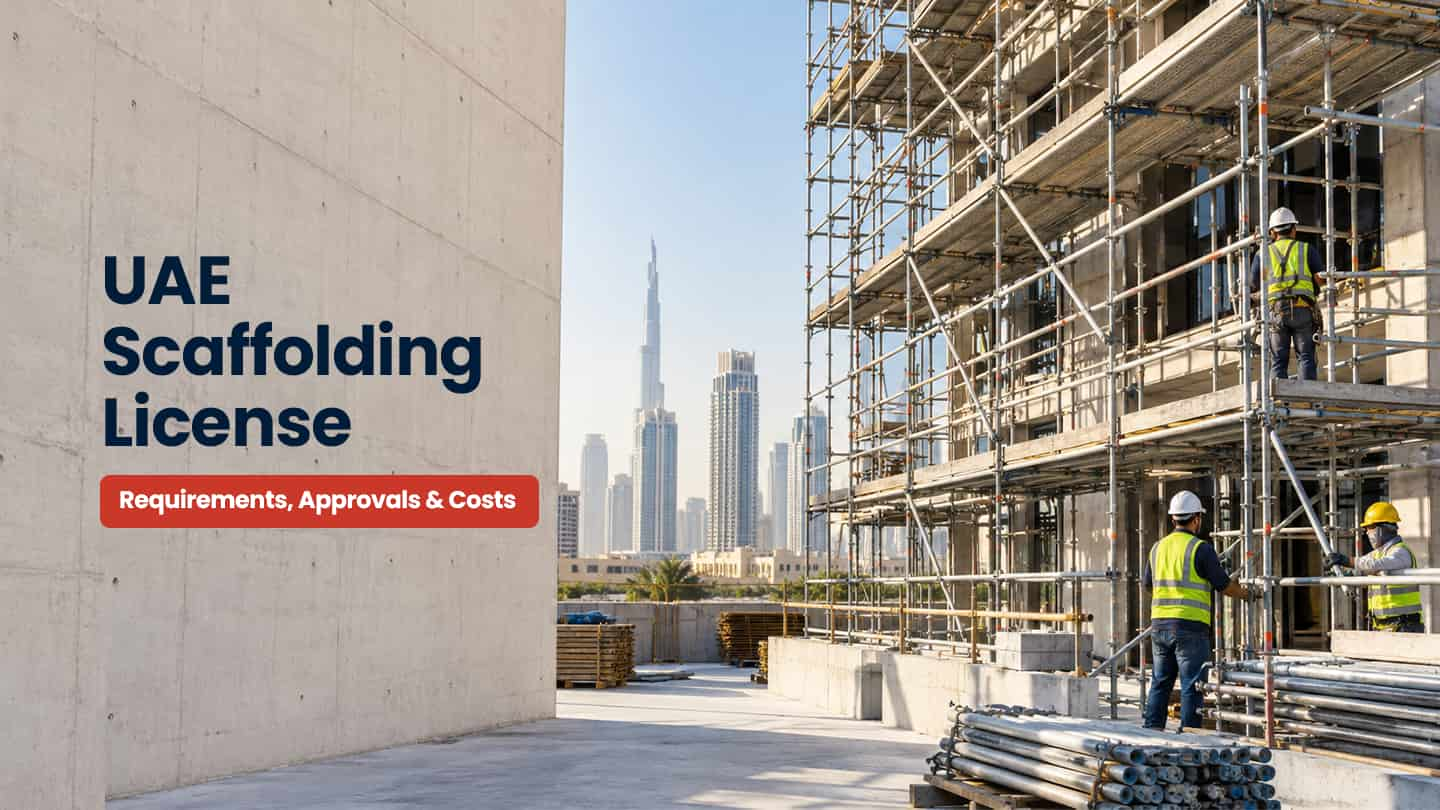
UAE Scaffolding License: Activity, Approvals & Requirements
Son güncelleme Nov 26, 2026
YazanNityansh Bhati
İnceleyenJacob Joy Mathew
100k+ | Businesses Registered
Bağlantı kuralım.
Table of Contents
Many entrepreneurs find a scaffolding license in UAE as one of the most complicated licenses. It is because the approvals can change with the activity you do. For instance, a company that sells scaffolding components is doing a different activity from a company that erects scaffolding on a live construction site.
There is another layer in this. A trade license gives your company the legal identity to operate, but it doesn’t make scaffold ready for use on a project. Inspection, certification, and site-specific safety requirements become part of the operation.
In this guide, we will understand the scaffolding license requirements in the UAE with a focus on Dubai. Let’s dive in.
Benefits of Starting a Scaffolding Business in Dubai
Dubai is one of the busiest construction markets in the region. Almost every construction project needs scaffolding at some stage. That makes scaffolding a steady, repeat-demand business rather than a one-off opportunity.
The market is also becoming more structured. Under Dubai Law No. 7 of 2025, contractors are brought into a unified Contractor Register. Due to this, companies can set up properly and stay compliant when bidding for projects.
Key benefits at a glance:
100% foreign ownership
Generally available for mainland activities outside the strategic negative list.
Multiple revenue models
Businesses can earn through equipment sales, rentals, erection services or combined supply-and-installation contracts.
Constant demand
Scaffolding is needed across residential and commercial projects.
Flexible business models
Choose trading, contracting or a mix, depending on your capital and goals.
Reusable core assets
Scaffolding stock can be used across multiple projects.
Growing demand for specialist access solutions
Complex structures and high-rise projects can create demand for specialised scaffolding and access systems.
Long-term contractor relationships
Main contractors and construction companies can provide repeat project opportunities when a scaffolding company has the required technical capability and compliance record.
Scaffolding Trading License v/s Scaffolding Contracting License
A trading license for scaffolding is designed around selling scaffolding systems and components. It covers the retail sale of scaffolding systems and components. It does not cover wholesale or manufacturing. It also does not cover scaffolding erection or rental services.
A scaffolding contracting business works differently. Its team goes to a client’s site and erects, alters or dismantles scaffolding. That creates direct responsibility for the work carried out by the crew and for the safety of the structure.
| Business activity | Typical route |
| Import and resell scaffolding components | Trading |
| Sell tubes, boards, fittings, and accessories | Trading |
| Rent scaffolding equipment | Equipment hire |
| Erect scaffolding at a project | Contracting |
| Alter or dismantle scaffolding | Contracting |
| Inspect and certify scaffolding | Separate 3rd party inspection function |
The important point is that a scaffolds trading license activity cannot automatically be stretched into an erection activity.
What Approvals You Need for a Scaffolding License?
A scaffolding company can deal with more than one authority. That depends on where the project is located. For a Dubai mainland contracting operation, the main setup can be viewed as a chain:
DET license → Dubai Municipality registration → technical competency → project approvals → scaffold inspection → site handover
Each stage deals with a different part of the business.
Also, a scaffolding contractor in Abu Dhabi does not simply carry the Dubai safety process into Abu Dhabi. Abu Dhabi has its own scaffolding licence requirements under its occupational safety framework. Sharjah has its own system as well. Certain free zones and development authorities also maintain dedicated HSE requirements.
Who is Responsible for Scaffold Inspection and Tagging?
Scaffolding inspection is one of the areas where operational discipline becomes more important than the license itself. A third party approved by Dubai Municipality inspects supported and suspended scaffolds and issues the relevant certificate of compliance.
You will also commonly see green and red scaffold tags used on construction sites. The practical meaning is straightforward:
- Green: inspected and available for use
- Red: do not use
However, the available material does not establish the green and red tag system as a specific Dubai Municipality statutory requirement. It is safer to treat it as established site practice rather than claim that the colours themselves are mandated by law.
The same care applies to inspection frequency. A weekly inspection cycle and additional inspection after alteration or severe weather are widely used safety practices. A specific Dubai Municipality re-inspection interval could not be firmly established from the available primary material.
Dubai Law No. 7 of 2025 for Scaffolding Contractors
Dubai Law No. 7 of 2025 creates a unified Contractor Register administered by Dubai Municipality through Invest in Dubai. The law was published on 8 July 2025 and came into force on 8 January 2026.
Existing contractors have a grace period running until 8 January 2027. New businesses should plan around the scaffolding licence requirements from the beginning.
The interesting part is the scope. The register covers contracting activity across Dubai. The framework also covers free zones and the DIFC. That means choosing a free zone does not automatically remove a contracting business from the wider contractor registration framework.
The framework also brings individual technical competence into the picture. Technical staff can require a Professional Competency Certificate. This is attached to the individual rather than simply to the company. A change in key technical staff can therefore become a compliance matter.
There is one important classification. The detailed activity list does not specifically named scaffolding or temporary works. The committee chaired by Dubai Municipality is responsible for the detailed activity framework. For that reason, the safest approach for a new scaffolding company is to plan for the Contractor Register and confirm the live activity classification before starting operations.
Do Scaffolders Need CISRS Certification in Dubai?
CISRS is widely recognised in the scaffolding industry and is commonly associated with trained scaffolding professionals in the UAE. But there is a difference between an industry standard and a named legal requirement.
CISRS is not a mandatory certification by name across Dubai. Instead, the requirements focus on assessment and approved training arrangements. Your team needs people who understand safe erection, alteration, dismantling and inspection procedures. Depending on the project, client and authority, specific training or certification may be required.
CISRS can therefore be highly relevant to your hiring and project strategy even where it is not established as a universal statutory requirement.
How do Scaffolding Rules Change Across UAE Jurisdictions?
There is no single scaffolding rulebook that works identically across every UAE construction site.
Abu Dhabi
Abu Dhabi’s occupational safety framework includes Code of Practice 26 for Scaffolding. It covers planning, risk assessment, design, foundations, loads, stability, working platforms, safe erection, alteration, dismantling, inspection and competency.
Dubai Municipality
Dubai Municipality’s Code of Construction Safety Practice contains Chapter 8 on Scaffolding Safety. It covers the construction and use of scaffolds along with inspection, maintenance, loads, platforms and stability.
Trakhees
Trakhees operates within areas under the Ports, Customs and Free Zone Corporation. Its Construction Safety Regulations contain Section 9 on Scaffolding. Requirements cover areas such as competent scaffolders, supervision, inspection, tagging, safe work practices and scaffolding towers.
DMCC
DMCC’s HSE guidelines include requirements covering scaffold erection, modification, dismantling, inspection, tagging, edge protection, safe access and harness use.
Dubai Development Authority
DDA’s HSE framework contains a dedicated section covering scaffolds and work platforms. It addresses stability, materials, inspection, working platforms, loads, guardrails, toe boards and fall prevention.
Sharjah
Sharjah’s occupational safety framework covers scaffolding through its work-at-height requirements. It includes areas such as risk assessment, competent supervision, design, erection, maintenance, dismantling, fall protection, public access and footpath scaffolding.
Documents Required for a Scaffolding Company
The documents depend on the legal structure and authority. A typical setup file can include:
- Passport copies of shareholders
- Recent photographs
- Current visa or entry status
- Preferred trade names
- Business activity and scope
- Staffing plan
- Incorporation documents
- Office and yard documents
- Technical staff credentials
- Contractor registration documents
- Insurance documents
- Project-specific approvals (if applicable)
A contracting business also needs to build a technical and operational file that demonstrates its ability to perform the work safely. This is because a vague activity description can create more work later when the company applies for contractor registration or starts bidding for projects.
Scaffolding Company Setup Cost in Dubai
The cost of a scaffolding company in Dubai starts from around AED 8,000 for the government license fee. However, the total cost depends on what the company does. For example, a trading business needs a license, a small office and some stock. Whereas, a contracting business needs all of that plus a yard, insurance, a certified technical team, and enough equipment to mobilise a crew.
Two costs are easy to miss. The first is working capital. Scaffolding contractors often mobilise stock and labour weeks before the first payment arrives, and retention amounts can hold back part of the payment even after the work is finished. The second is the compliance cost that continues after setup. These can include license renewal, Ejari renewal, insurance, inspection, and keeping technical staff certificates current.
How Much Scaffolding Stock Should a New Company Buy?
Stock is the largest asset a scaffolding business owns, and it is also where new companies most often over-commit. The safer approach is to size your first purchase around the work you can realistically win.
These principals help when planning the first purchase:
Start from the first contracts
Work out the scaffold area, height, and duration of the jobs you are bidding for. If you have no confirmed work yet, keep the first purchase deliberately small.
Standardise on one system first
Cup lock, ring lock, tube & fitting, and aluminum towers – each need different components and skills. Building depth in one system is cheaper than holding a thin stock of everything.
Buy the core components in balance
Standards, ledgers, braces, base jacks, U-heads, boards, couplers, toe boards, ladders, and stair units are only useful together. A shortage of one component can hold up an entire job.
Consider a hybrid model
Many new contractors buy the core stock they will reuse constantly and rent the balance for larger projects. This keeps cash available for wages, insurance, and inspection.
Insist on documented quality
Ask suppliers for test certificates and confirm the material meets the standards your clients expect. Damaged or unidentifiable components should not go back in service.
Plan for storage and tracking
Stock needs a yard and a system for counting what leaves and returns. Losses and wear are a real cost, so allow for them.
Match stock to your cash flow
Plan purchases around expected contracts and payment cycles, so you have enough working capital for wages, rent and other operating expenses.
If you are also running a trading farm, keep the resale stock and your working stock separate in your records. It makes inspection and VAT treatment cleaner.
How Does the UAE Summer Affect Scaffolding Operations?
The UAE summer creates a specific planning issue for outdoor construction work. The annual midday break restricts outdoor work in direct sunlight from 12:30 pm to 3:00 pm between 15 June and 15 September. If violated, the penalty is AED 5,000 per worker with a maximum of AED 50,000.
For a scaffolding contractor, this can affect project productivity because much of the work takes place outdoors. A project that is financially viable during winter productivity levels can produce a very different margin when part of the outdoor working day is unavailable.
What is a Scaffold Pavement License?
The phrase scaffold pavement license is sometimes used when discussing scaffolding that occupies or affects a public footpath.
It is related to the additional safety and public-assess requirement that can arise when scaffolding affects a footpath or public area. Sharjah’s scaffolding guidance specifically addresses public access and footpath scaffolding along with exclusion zones, signs, fall protection and related controls.
The same principle applies elsewhere. So, if scaffolding extends into an area used by the public, check the authority responsible for that location before installation.
How to Start a Scaffolding Company in Dubai?
A practical setup sequence looks like this:
Step 1: Decide What the Business Will Actually Do
Start with the activity because everything else follows from it. A trading activity cannot be stretched into erection later without changing the license. Also note where your projects will be, as each jurisdiction has their own safety framework.
Step 2: Choose Your Jurisdiction and Legal Structure
For an on-site scaffolding erection in Dubai, plan for a mainland DET license carrying a contracting activity. A pure scaffolds trading license business may have other options. An LLC is the most common structure in this case.
Step 3: Reserve a Trade Name and Get Initial Approval
Reserve a trade name that follows DET naming rules and reflects the activity. Then apply for initial approval.
Step 4: Secure Your Office and Yard
A mainland license needs an Ejari-registered lease. For a scaffolding business, the office is only part of the picture as stock and vehicles also need space.
Step 5: Draft the MOA and Obtain the DET License
For an LLC, the Memorandum of Association sets out the shareholders and capital, and it is notarized before license is issued. Submit the application with your approvals, pay the fees, and collect the license.
Step 6: Register with Dubai Municipality and the Contractor Register
Register through the Invest in Dubai platform and apply for classification. Confirm the live activity classification for your business before the operations start.
Step 7: Build Your Technical Team
Hire supervisors and scaffolders who understand safe erection, alteration, and dismantling. Key technical staff may need a Professional Competency Certificate, which belongs to the individual rather than the company.
Step 8: Set Up Insurance and Safety Documents
Arrange the insurance cover your projects will require. Prepare risk assessments, method statements, and a site safety plan that match the authority you are working under.
Step 9: Complete Visa and Tax Requirements
Open your establishment card and labour file, process visas, medicals and Emirates ID. Also open a corporate bank account. Register for corporate tax, and for VAT after your taxable supplies meet the registration threshold.
Step 10: Buy Stock, Prequalify and Bid
Purchase your initial stock. Keep your first order tied to real projects. Build a compliance file covering your license, registration, insurance, certificates, and safety documents. Then apply to be listed with main contractors.
How Shuraa Business Setup Helps You Start a Scaffolding Company?
To start a scaffolding company in the UAE, founders must go through multiple approval stages. Also, they must ensure that they provide the right info and meet every compliance requirement at every part of their business setup process, so that they don’t not face any unnecessary delays or additional costs.
With 26+ years of experience in the UAE business setup industry and 100,000+ clients served, Shuraa Business Setup works with entrepreneurs and businesses across different industries and licensing jurisdictions.
Our team can support you with:
- Scaffolding business activity selection
- Mainland company formation
- Trade license processing
- Office and premises requirements
- Contractor registration guidance
- Visa and establishment services
- Corporate bank account assistance
- Tax and accounting support
- Ongoing compliance requirements
Shuraa can help you structure your scaffolding company around the work you actually plan to undertake. For a more comprehensive analysis of your application, book a FREE consultation with Shuraa experts today.
Frequently Asked Questions
What are the scaffolding license requirements in Dubai?
For onsite contracting, the setup can involve a mainland DET license with the relevant contracting activity, Dubai Municipality contractor registration, technical competency requirements and third-party scaffold inspection.
Do I need Dubai Municipality registration for scaffolding contracting?
Dubai Municipality contractor registration forms part of the Dubai contracting structure described in the available material. Contractor classification considers financial, technical and administrative capacity.
Is CISRS legally required for scaffolders in Dubai?
The available material does not establish CISRS as a universal named legal requirement in Dubai. It is widely recognised within the industry. Specific project and authority requirements should be checked before hiring or assigning technical staff.
How much does a scaffolding company cost to set up in Dubai?
Dubai government license fees for a scaffolding business in Dubai cost starts with a base of AED 8,000 plus 5% of rent. Office rent, visas and external approvals are additional.
Can foreigners own a scaffolding company in Dubai?
100% foreign ownership is generally available for mainland activities outside the strategic negative list. Activity-specific confirmation should be obtained during the licensing process.
Where do Trakhees scaffolding rules apply?
Trakhees requirements apply in areas under the jurisdiction of the Ports, Customs and Free Zone Corporation. Its Construction Safety Regulations contain dedicated scaffolding requirements.
Can a scaffolding company open a corporate bank account in the UAE?
Yes. The company can apply for a corporate bank account after incorporation. A strong application should include the trade license, company documents, premises information and evidence explaining the company’s activities and expected transactions.
Leave a Comment
No comments yet. Be the first voice in the void.

Nityansh, BAE şirket formasyon ve düzenleyici çerçevelere odaklanarak iş içerik yöneticisi ve uluslararası pazar danışmanıdır. Karmaşık düzenleyici gereklilikleri ve sınırları açık içgörüler tercümeleri tercüme eder. Onun çalışması, girişimcilerin BA…